Source: Pisani, Imagining Native America in Music
1 2022-05-19T19:37:49+00:00 Luca Connors ced9dd0f9f64a731c75f8e47663d30a132fa944a 18 1 plain 2022-05-19T19:37:49+00:00 Luca Connors ced9dd0f9f64a731c75f8e47663d30a132fa944aThis page is referenced by:
-
1
media/Dvořák_NewWorldSymphony_TitlePage.jpeg
2022-05-19T04:01:50+00:00
Composition
90
An Example of Indianist Composition
image_header
2022-06-07T20:21:23+00:00
Many composers of Euro-American art music have attempted to “incorporate” elements of Indigenous musics into their works. What words like “incorporate,” “influence” and “inspire'' in these contexts fail to address, however, is that these composers were taking elements of Indigenous songs completely out of context and forcing them into the constraints of Western music theory. The main surge in these efforts, now called the Indianist movement, was one of many forms of colonial extractivism taking place in the late 19th century. Much of the Indianist movement stemmed from a pressure for composers to create a sound that was distinctively “American,” just as European composers had begun to attempt to evoke the sounds of their respective countries. Such an interest in American musical nationalism was largely brought into momentum by the well-known Bohemian composer Antonín Dvořák, who discouraged American composers from following the style of European works. While visiting the U.S. for about three years, Dvořák sought to find suggestions for possible “inspirations” of a uniquely American sound, looking to some of the most marginalized communities in the country for that material.
Dvořák’s Symphony No. 9, premiered in December 1893 and commonly known as the New World Symphony, is one of the most famous compositions known to have been “inspired” by both Indigenous and Black musics. While this reputation is widely circulated today, one might be surprised to learn that Dvořák appears to have fabricated the notion that he had any knowledge of the characteristics of Indigenous musics during his composition process. Upon the completion of the symphony in May of 1893, Dvořák interviewed with the New York Herald, claiming to only have sourced his “inspiration” from Black spirituals. It wasn’t until seven months later in another Herald interview, published a day before the symphony’s premiere, that Dvořák mentioned drawing from Indigenous “influences” (Pisani, 2005: 186).
In this interview, Dvořák elaborated that he had never actually sourced Indigenous music itself as inspiration, only the “color” or “spirit” that is evoked at the thought of their cultures, as well as studying what some scholars were calling the “peculiarities'' of Indigenous musics. In an attempt to embody the “Indian spirit”, Dvořák drew inspiration from The Song of Hiawatha, a poem featuring Indigenous characters by Henry Wadsworth Longfellow (Pisani, 2005: 146). As for the “peculiarities” of Indigenous musics, Dvořák was likely referring to a report by music theorist John Comfort Fillmore that used such a phrasing. The report, published in August of 1893, detailed the “structural peculiarities” of the songs studied by Alice C. Fletcher with Francis La Flesche in A Study of Omaha Music. In fact, Fillmore sent a copy of the report to Dvořák during his stay at the August 1893 Chicago World’s Fair in hopes that he would consider Indigenous musics as a source for the new “American” sound (Deloria, 2004:195; Pisani, 2005: 187). Up until this point, there is no evidence that Dvořák claimed any direct inspiration for the New World Symphony from Indigenous musics (Pisani, 2005: 188). It appears Dvořák decided to tack on Indigenous “influence” as an afterthought, likely for the sake of publicity and strengthening his case for a national “American” sound.
Since Dvořák appears to have never actually studied Indigenous musics prior to completing his symphony, the suggestion that Indigenous musics served as any “inspiration” while composing the work appears to be very misleading. At the time, however, Dvořák was likely able to justify this deception due to the widespread confusion among European Americans about the differences between Black and Indigneous musics. His second interview with the Herald put particular emphasis on the “similarities” between Black and Indigenous musics, identifying a perceived commonality in the pitch content of the two musical practices. Within Euro-American understandings of music theory, this commonality is categorized as a pentatonic scale, which was notoriously labeled as “primitive” at the time. This conflation of Black and Indigenous musics allowed the two practices to be viewed as a vaguely “Indigenous” sound, which worked in Dvořák’s favor in his efforts to create a moe uniquely “American” musical identity, while erasing the distinct cultural practices of the two marginalized groups. This carelessness, along with Dvořák's treatment of Indigenous musics as an afterthought, has led to the inaccurate, decontextualized, and vague evocations of Black and Indigenous musics in the New World Symphony that are still romanticized and revered today.
Works Cited:- Deloria, Philip J. 2004. “The Hills are Alive…with the Sound of Indian” in Indians in Unexpected Places. Lawrence, Kan: University Press of Kansas. 183-223.
- Fillmore, John C. 1893. “Report on the Structural Peculiarities of the Music” in A Study of Omaha Indian Music by Alice C. Fletcher and Francis La Flesche. Archaeological and Ethnological Papers of the Peabody Museum, 1 (5). Cambridge, Mass. Peabody Museum of Archaeology and Ethnology. 59-77.
- Pisani, Michael V. 2005. Imagining Native America in Music. New Haven, Con. Yale University Press.
-
1
media/cover page Zoe.jpg
2022-05-28T19:12:56+00:00
The Smithsonian and the Bureau of American Ethnology
5
A summary of the history of these institutions and their involvement in the development of ethnomusicology and its colonial legacies.
image_header
2022-06-08T16:20:18+00:00
The Smithsonian Institution was founded in 1846 at the bequest of James Smithson, an Englishman who had never been to the United States, but nonetheless believed it was essential for the “increase and diffusion of knowledge” (Smithsonian “Our History”). In 1876, the Smithsonian was placed in charge of putting together the “North American Indian” exhibit for Philadelphia’s Centennial Exhibition. The head of the project, Spencer F. Baird, chose to accomplish this by hiring an armada of amatuer ethnologists and instructing them to “collect” objects, specifically those that “did not appear to be influenced by white contact”(cited in Puckett). This resulted in an incredibly haphazard and piecemeal exhibition of objects crucially lacking their cultural context, and despite a stated intention to “enlighten the public about native cultures,” the exhibit ultimately did nothing more than reinforce pre-existing stereotypes (Puckett).
The Bureau of American Ethnology (hereafter the BAE) was established by the federal government in 1879 and placed under the purview of the Smithsonian Institution. The need for such an institution stemmed from the problematic disorganization of prior efforts by the United States government to collect extensive information about the unique ways of living possessed by Indigenous populations in territories occupied by the settler colonialists (Genealogy). This was a way of “knowing”--and thus governing–the subject peoples. The Smithsonain and the BAE “were interested in bringing science to bear on the mapping of the West” (Pisani 2005:165). An embodiment of the type of “scientific” values championed by these joint institutions, John Wesley Powell was appointed as the first director of the BAE in 1879. Though he never received a degree (the Civil War interrupted his efforts), Powell studied the sciences at Illinois Institute, Illinois College, and Oberlin College(Wikipedia). He headed expeditions to pursue ethnological, anthropological and geographical information in Colorado, and became the second director of the U.S. Geological Survey. His passion for the Bureau’s work was sparked by his belief that “the study of such ‘savagery,’ as [Powell] called it, would help preserve the tribes and knowledge about them” (Graphic Arts Spotlight).
Starting in 1881, the BAE published annual reports to the Secretary of the Smithsonian. In 1907, Frances Densmore wrote to the BAE asking for funding to continue work she had begun, studying how music was intrinsically tied into Chippewa medicine practices. She was granted the funding, and her work was published later that year in the 1907 BAE report, marking the first time the Bureau published any research related to music. The same year, Alice Fletcher contributed a section on music to the BAE’s “Handbook of North American Indians.” After these preliminary contributions, the BAE continued to fund Desnmore’s research (though this funding was temporarily paused because of government cutbacks during the Great Depression) until her death in 1957. Other researchers who made contributions about music to BAE annual reports until the year 1948 include Francis La Flesche (Omaha), Walter Edmund Roth, J. N. B. Hewitt, Helen H. Roberts, James A. Teit, Edwin Thompson Denig, Leslie A. White, M. W. Stirling, William Jones, Ralph L. Beals, John R. Swanton, Ruth L. Bunzel, and Alfred Métraux. Many others contributed after this time.
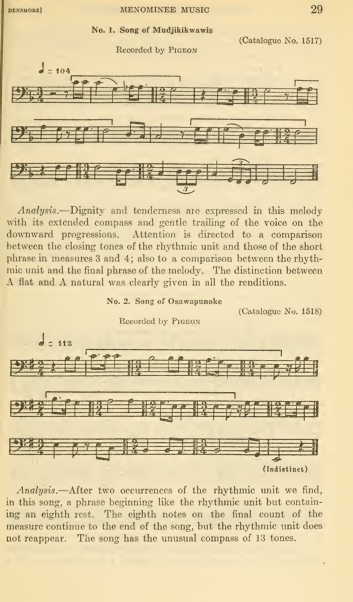
The BAE’s activity was not, however, limited to its annual reports. Following its establishment, the BAE published almost 200 bulletins specifically related to Indigenous peoples, although the focus on music was limited. These bulletins are particularly noteworthy because they are the source of some of the earliest published transcriptions, such as Densmore’s transcriptions of “Menominee Music” in BAE Bulletin 102. However, the BAE also disseminated research results in more widely accessible publications such as Scribner's, Harper's, Popular Science Monthly, Century Illustrated, and the Atlantic Monthly (Pisani 2005: 168). Another area in which the BAE exercised its public influence was in its sponsorship of an “Indian Congress” at the 1898 Trans-Mississippi and International Exposition, held in Omaha. This event epitomized the BAE’s focus on “salvage ethnography,” with Edward Rosewater, the head of the event’s department of publicity stating that it “undoubtedly would be the last gathering of these tribes before the bronze sons of the forests and plains, who have resisted the encroachments of the white man, are gathered to the happy hunting ground,” and that “demand was high for an extensive exhibition illustrative of the life and customs ‘and decline of the aboriginal inhabitants of the Western Hemisphere’” (Pisani 2005:175). However, any purported desire to adhere to the institution’s root in science was abandoned in favor of entertainment, with the event “having degenerated into Wild West shows and sham Indian battles - gaudily advertised on huge poster boards and clearly designed to increase ticket sales” (Pisani 2005: 175). Ultimately, the Smithsonian and the BAE stand as important institutions contributing to the colonial legacies found in ethnography and ethnomusicology today because of their unique situation disseminating knowledge. This knowledge was framed for the public as “scientific” but their rationales and motivations for calling it such can be questioned.
Further Citations/References
“Frances Densmore: Pioneer in the Study of American Music.”
“Alice Cunningham Fletcher and Francis La Flesche in the Transcription Center.”
Frances Densmore and American Indian Music: A Memorial Volume.
“About the Museum.”
“River Basin Surveys Instituted in Bae.”
“Smithsonian Institution. Bureau of American Ethnology.”