This content was created by Helena Colindres. The last update was by Luca Connors.
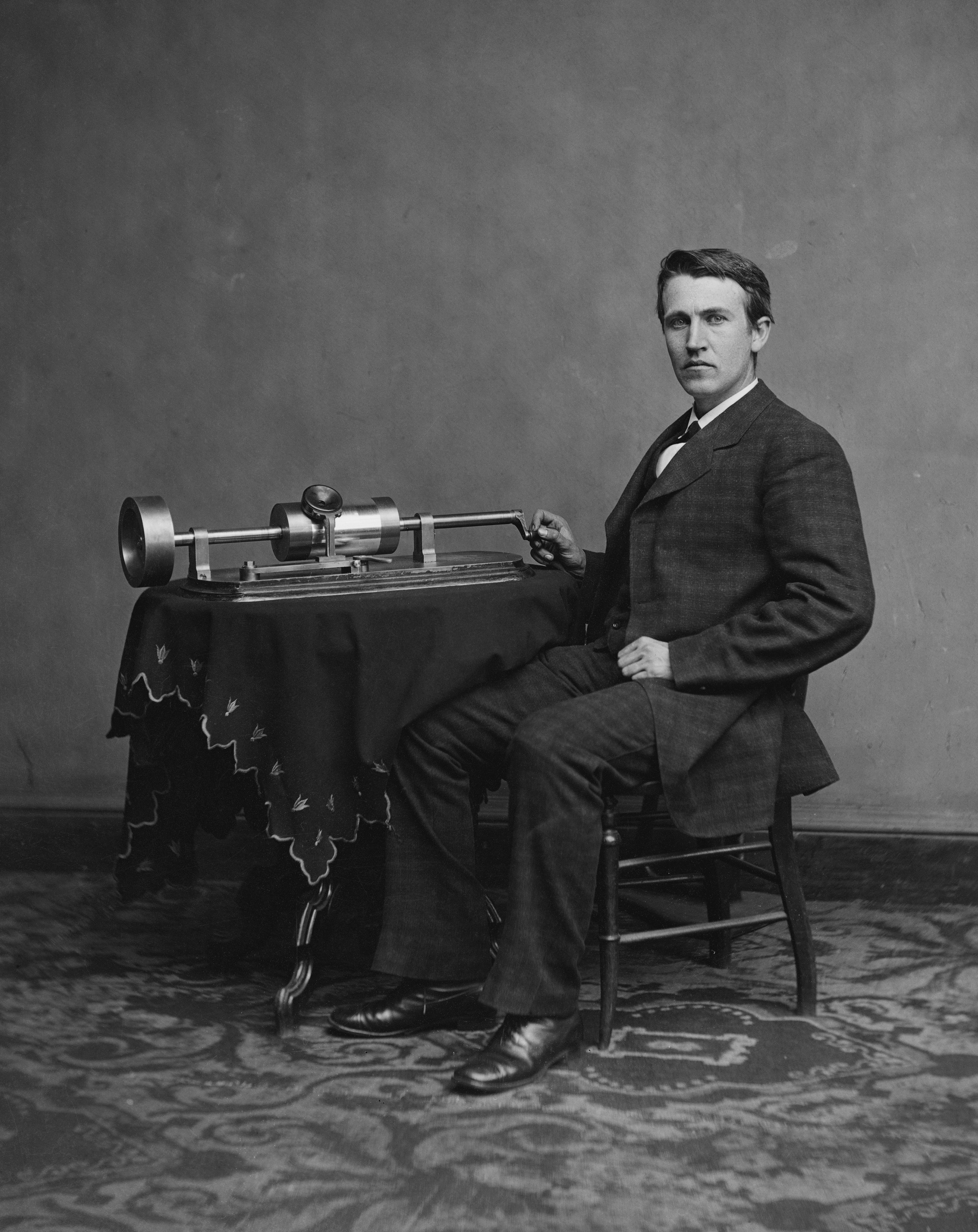
Image: The Phonograph
1 media/Edison_Home_Phonograph_1901_thumb.jpg 2019-12-21T00:08:56+00:00 Helena Colindres 0c4e96608d23ebe552d79cf7c777fbff5194ea7f 18 2 A Drawing of the Phonograph plain 2022-05-26T21:40:46+00:00 1901 Luca Connors ced9dd0f9f64a731c75f8e47663d30a132fa944aThis page is referenced by:
-
1
media/Henry Rowe Schoolcraft.jpeg
2022-05-30T18:59:46+00:00
The Discipline of Folklore in the Nineteenth Century
26
plain
2022-06-07T20:37:27+00:00
In the introduction to 100 Years of American Folklore Studies, published in 1988 on the 100th anniversary of the founding of the American Folklore Society (AFS), President Alan Jabbour wrote, “It behooves us always… to reflect on the ancestral missions that have shaped us, the inherited values that we reflect and must radiate into the future” (Jabbour, vii). 100 years earlier, the AFS was built on the frameworks of white intellectuals such as Henry Rowe Schoolcraft, whose four main objectives of the brand new discipline of Folklore were to document,
“(1) physical type of man;
(2) material existence [material culture]...
(3) intellectual existence including music and poetry, oral tales and legends, medical knowledge, and mythology; and
(4) geographical phenomena affecting or modifying the above features'' (McNeil, 2)This desire of Schoolcraft’s and of other intellectuals and anthropologists of the time to observe, analyze, and categorize the bodies and cultures of various groups of people was focused on Indigenous peoples in North America, and was spurred by the belief that Indigenous peoples were “dying out,” their cultures were disappearing, and “civilized” America must rescue the “primitive customs,” not the people, from this inevitable fate (Pisani, 73).
In the years following its founding, the AFS continued to practice salvage ethnography. Much of the material that was collected and written about by members of the AFS was published in the accompanying journal, The Journal of American Folklore (JAF). Although the AFS endeavored to include material taken from both Indigenous peoples in North America that was collected by anthropological folklorists known as “the Indian men,” and European folklore collected by “literary folklorists” or “English folklorists,” a small minority of the material published in the JAF was European (Zumwalt, 9). William Wells Newell, the first active president of the AFS, considered the discipline of folklore to be included within anthropology. Newell argued, “In its broader meaning..., folklore is a part of anthropology and ethnography, embracing the mental side of primitive life, with especial reference to the narratives in which beliefs and habits are related or accounted for” (Zumwalt, 9). Anthropological folklorists traveled to Indigenous groups around North America, collecting written stories as well as narratives and songs recorded on the phonograph.
In the wake of Charles Darwin’s Origins of the Species (1859), the theory of evolution began infiltrating all disciplines, including the study of society and culture in the form of social darwinism (Bronner, 6). According to Hugo A. Freund in the article, “Cultural Evolution, Survivals, and Immersion: The Implications for Nineteenth-Century Folklore Studies,” Daniel Garrison Brinton, second president of the AFS, “focused less on the investigation of individual cultures than on evaluating them in comparison to modern western civilization” (12). This claim about Brinton’s practices lays bare another nefarious impetus of nineteenth-century folklorists: to prop up their own “superior” civilization at the top of their constructed hierarchy by reestablishing that “primitive cultures,” (amalgamated into one “other”), belonged at the bottom. They did this by constantly reaffirming that the musics, stories, and rituals that they extracted from Indigenous peoples were at “basic” levels of development, and were struggling to become the same as those of the West.
They then analyzed and published these stories in publications such as the JAF, whereupon they were consumed and dissected by other white academics such as Alice Cunningham Fletcher, John Comfort Fillmore, and Jesse Walter Fewkes. -
1
2019-12-20T23:12:57+00:00
The Phonograph
1
A Colonial Legacy
plain
2020-01-03T16:17:47+00:00
The invention of the phonograph, which allowed sound to be recorded for the first time, changed the way people conducted research within the fields of musicology, ethnology, and anthropology, thereby laying the groundwork for the field that would come to be known as ethnomusicology. Prior to this technological invention, the only way that people could capture sound was through written transcriptions which at the time often utilized “Western” staff notation.
The first phonograph was invented by Thomas Edison and was built by John Kreusi in December of 1877. This machine utilized a stylus which recorded sound vibrations as indentations onto a piece of tin foil which was wrapped around a metal cylinder. The vibrations were made in a vertical groove pattern. This phonograph had two needles, one for recording and the other for playback. Thomas Edison went on to establish the Edison Speaking Phonograph Company in January of 1878. His phonograph machine was an instant success due to the fact that people could now take notes without having to write them down. A drawback, however, was that it was difficult for the average person to operate and the tin foil would cease to function after just a couple of playbacks. These are the main reasons leading to Volta Laboratory creating the first “graphophone” in 1888.The graphophone was invented by Alexander Bell because he believed that the phonograph needed to record sound onto something less fragile than tin foil. He was the first to record sound onto wax cylinders. These early wax cylinders had the capacity to record two minutes of sound which was significantly more than Edison’s original tin foil model.
In the 1890’s Emile Berliner invented the technology which recorded the sounds onto flat discs. He coined the term, “gramophone”, and made the record player popular.
All three of these inventions played a pivotal role in the fields listed above because they made it possible for academics and field researchers alike to record music and and the languages of people all over the world. This is an important colonial legacy within the context of the United States because it was a tool that researchers and ethnologists relied on heavily within the practice of what is called today “salvage ethnography.” Both White and Indigenous people recognized that it was beneficial to record these musical and linguistic practices because they were threatened. These recordings offered documentation which could be passed down to future generations. It is interesting to explore the differential investments and rationales for engagement in this practice between settler ethnographers and Indigenous participants.The academics and researchers in the fields of ethnology who recorded in the late 19th and early 20th centuries often did this work because they wanted to save and preserve these practices by presenting their findings in museums and putting them on display for people. The reasons that Indigenous people took part in these projects was because they wanted future generations to experience a moment frozen in time from their cultural history. Other people, such as Laura Boulton, who was a collector in the mid-twentieth century, wanted to have these recordings for their own personal libraries of cultural artifacts. These collectors were not interested in sharing these materials with the communities from whom they were collected.
The original phonograph recordings have been kept in libraries, archives, and museums, sites which were inaccessible to many Indigenous communities. Sometimes they were eventually copied onto other means such as records, tapes, and CDs. It was not until the later half of the twentieth century that copies of these recordings started being repatriated to the Indigenous people--or their descendants-- whose voices were recorded on them.
By the time that these recordings started to be repatriated, these recordings have already gone through a great deal of mistreatment and neglect. For example, the recordings that Frances Densmore made from 1907 to 1941 by traveling to Indigenous lands were almost entirely forgotten about in the Library of Congress for almost fifty years! These recordings were often mislabeled and distorted as well.
The invention of the phonograph has made it possible for us to have access to the voices of Indigenous people from over a hundred years ago whether we are looking for ways to connect with the traditional songs or languages that in some cases have died out or are slowly dying. But just like any colonial tool, they were also a way that White settlers were able to take sacred objects and music away from the communities thereby further disrespecting Indigenous cultures.