This content was created by Momo Suzuki. The last update was by Luca Connors.
Image: Dr. Densmore, Collaborator with the Bureau of American Ethnology
1 media/densmore_smithsonian_business_card_nd_thumb.jpg 2019-12-20T19:55:31+00:00 Momo Suzuki 02e1334ead3dc86d1e81c381889089e420bb1abd 18 2 Business card showing Densmore as collaborator Bureau of American Ethnology plain 2022-05-26T21:01:51+00:00 Post-1950 Frances Theresa Densmore Papers, 1886-1904, Record Group 30/156, Series II. Pencil Sketches and Concert Programs (Folder 4), Oberlin College Archives. Luca Connors ced9dd0f9f64a731c75f8e47663d30a132fa944aThis page has annotations:
- 1 2019-12-20T20:40:47+00:00 Jennifer Fraser 404477000adfd4e5c7a1128cfac82e1fc740e8c3 Annotation: Official role: collaborator Luca Connors 3 plain 2022-05-30T18:43:59+00:00 Luca Connors ced9dd0f9f64a731c75f8e47663d30a132fa944a
This page is referenced by:
-
1
media/cover page Zoe.jpg
2022-05-28T19:12:56+00:00
The Smithsonian and the Bureau of American Ethnology
5
A summary of the history of these institutions and their involvement in the development of ethnomusicology and its colonial legacies.
image_header
2022-06-08T16:20:18+00:00
The Smithsonian Institution was founded in 1846 at the bequest of James Smithson, an Englishman who had never been to the United States, but nonetheless believed it was essential for the “increase and diffusion of knowledge” (Smithsonian “Our History”). In 1876, the Smithsonian was placed in charge of putting together the “North American Indian” exhibit for Philadelphia’s Centennial Exhibition. The head of the project, Spencer F. Baird, chose to accomplish this by hiring an armada of amatuer ethnologists and instructing them to “collect” objects, specifically those that “did not appear to be influenced by white contact”(cited in Puckett). This resulted in an incredibly haphazard and piecemeal exhibition of objects crucially lacking their cultural context, and despite a stated intention to “enlighten the public about native cultures,” the exhibit ultimately did nothing more than reinforce pre-existing stereotypes (Puckett).
The Bureau of American Ethnology (hereafter the BAE) was established by the federal government in 1879 and placed under the purview of the Smithsonian Institution. The need for such an institution stemmed from the problematic disorganization of prior efforts by the United States government to collect extensive information about the unique ways of living possessed by Indigenous populations in territories occupied by the settler colonialists (Genealogy). This was a way of “knowing”--and thus governing–the subject peoples. The Smithsonain and the BAE “were interested in bringing science to bear on the mapping of the West” (Pisani 2005:165). An embodiment of the type of “scientific” values championed by these joint institutions, John Wesley Powell was appointed as the first director of the BAE in 1879. Though he never received a degree (the Civil War interrupted his efforts), Powell studied the sciences at Illinois Institute, Illinois College, and Oberlin College(Wikipedia). He headed expeditions to pursue ethnological, anthropological and geographical information in Colorado, and became the second director of the U.S. Geological Survey. His passion for the Bureau’s work was sparked by his belief that “the study of such ‘savagery,’ as [Powell] called it, would help preserve the tribes and knowledge about them” (Graphic Arts Spotlight).
Starting in 1881, the BAE published annual reports to the Secretary of the Smithsonian. In 1907, Frances Densmore wrote to the BAE asking for funding to continue work she had begun, studying how music was intrinsically tied into Chippewa medicine practices. She was granted the funding, and her work was published later that year in the 1907 BAE report, marking the first time the Bureau published any research related to music. The same year, Alice Fletcher contributed a section on music to the BAE’s “Handbook of North American Indians.” After these preliminary contributions, the BAE continued to fund Desnmore’s research (though this funding was temporarily paused because of government cutbacks during the Great Depression) until her death in 1957. Other researchers who made contributions about music to BAE annual reports until the year 1948 include Francis La Flesche (Omaha), Walter Edmund Roth, J. N. B. Hewitt, Helen H. Roberts, James A. Teit, Edwin Thompson Denig, Leslie A. White, M. W. Stirling, William Jones, Ralph L. Beals, John R. Swanton, Ruth L. Bunzel, and Alfred Métraux. Many others contributed after this time.
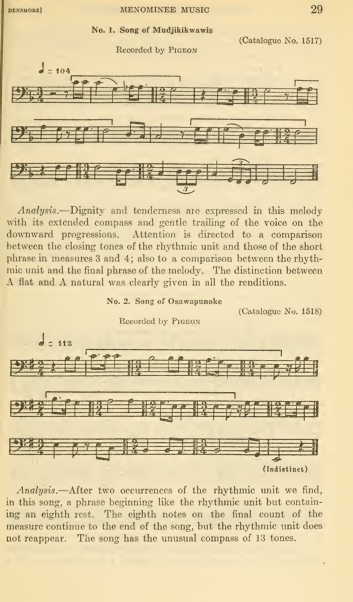
The BAE’s activity was not, however, limited to its annual reports. Following its establishment, the BAE published almost 200 bulletins specifically related to Indigenous peoples, although the focus on music was limited. These bulletins are particularly noteworthy because they are the source of some of the earliest published transcriptions, such as Densmore’s transcriptions of “Menominee Music” in BAE Bulletin 102. However, the BAE also disseminated research results in more widely accessible publications such as Scribner's, Harper's, Popular Science Monthly, Century Illustrated, and the Atlantic Monthly (Pisani 2005: 168). Another area in which the BAE exercised its public influence was in its sponsorship of an “Indian Congress” at the 1898 Trans-Mississippi and International Exposition, held in Omaha. This event epitomized the BAE’s focus on “salvage ethnography,” with Edward Rosewater, the head of the event’s department of publicity stating that it “undoubtedly would be the last gathering of these tribes before the bronze sons of the forests and plains, who have resisted the encroachments of the white man, are gathered to the happy hunting ground,” and that “demand was high for an extensive exhibition illustrative of the life and customs ‘and decline of the aboriginal inhabitants of the Western Hemisphere’” (Pisani 2005:175). However, any purported desire to adhere to the institution’s root in science was abandoned in favor of entertainment, with the event “having degenerated into Wild West shows and sham Indian battles - gaudily advertised on huge poster boards and clearly designed to increase ticket sales” (Pisani 2005: 175). Ultimately, the Smithsonian and the BAE stand as important institutions contributing to the colonial legacies found in ethnography and ethnomusicology today because of their unique situation disseminating knowledge. This knowledge was framed for the public as “scientific” but their rationales and motivations for calling it such can be questioned.
Further Citations/References
“Frances Densmore: Pioneer in the Study of American Music.”
“Alice Cunningham Fletcher and Francis La Flesche in the Transcription Center.”
Frances Densmore and American Indian Music: A Memorial Volume.
“About the Museum.”
“River Basin Surveys Instituted in Bae.”
“Smithsonian Institution. Bureau of American Ethnology.” -
1
media/Densmore Sketches.jpg
2019-12-21T21:52:29+00:00
Critical Perspectives on Densmore's Approaches
3
plain
2022-05-28T18:36:44+00:00
It would be easy to glorify her for her life-long commitment to her career, but I think it is important to address serious concerns in her approaches. We can give credit to Densmore’s commitment to her work without overlooking the power dynamics between settlers and Indigenous peoples that she exploited and perpetuated. This is imperative when teaching or learning about Densmore, because we do not want to overlook or perpetuate these imbalanced power dynamics.- Densmore did not study Indigenous peoples’ music in order to help or benefit them. Even in wanting to save Indigenous customs before they disappeared, she did not practice salvage ethnography so that Indigenous people could be connected to their heritage. She published and archived the materials she collected on behalf of and for other settlers and colonialist institutions, such as the Smithsonian and the Library of Congress. This is why it’s imperative that these recordings now take on a new life that serves their original bearers.Densmore, like many early ethnologists, was steeped in Western Art Music. She carried her rigorous classical music training from Oberlin Conservatory (1884-1886) into how she wrote down (transcribed) and analyzed Indigenous music.
- Despite noting the limitations of staff notation developed for Western Art Music, she did not abandon it because she wanted to find generalizable patterns and not hone in on specifics.
- Densmore superimposed not only the theoretical framework designed for Western Art Music, but its valuing of analysis onto the Indigenous music she was studying. She methodically dissected, categorized, tagged, and theorized about the Indigenous music that she transcribed and recorded. She chose to do this over treating and appreciating the music in the ways that Indigenous people did. She also did not take on ethnomusicological approaches that were developed later, such as learning to play the music, learning the language, or immersing herself in the cultural context for a long time.
- Despite learning about their significance, she still recorded sacred music such as those of the Midewiwin (Grand Medicine Society). In doing so, she prioritized her scholarly interests and her analytical relationship to music over what the music means to Indigenous people.
- Densmore approached Indigenous people as “other” and started her studies and writings with a romanticized notion of how Indigenous people lived and thought at the time of her work.
- Densmore saw elements of music as representative of relative levels of evolution and operated with an attitude that denied coeval existence of the Indigenous peoples she worked with.
- She grouped together Indigenous musics and practices in her attempt to study them. Instead of focusing on an individual group of people, she fell into the colonialist trope of homogenizing various Indigenous groups.
- Densmore muddied consent in her practices. She transcribed Indigenous peoples’ music before they started giving her permission. Even when Indigenous people gave Densmore permission, they may have been pressured through her negotiations and the power that she had as a white, settler.