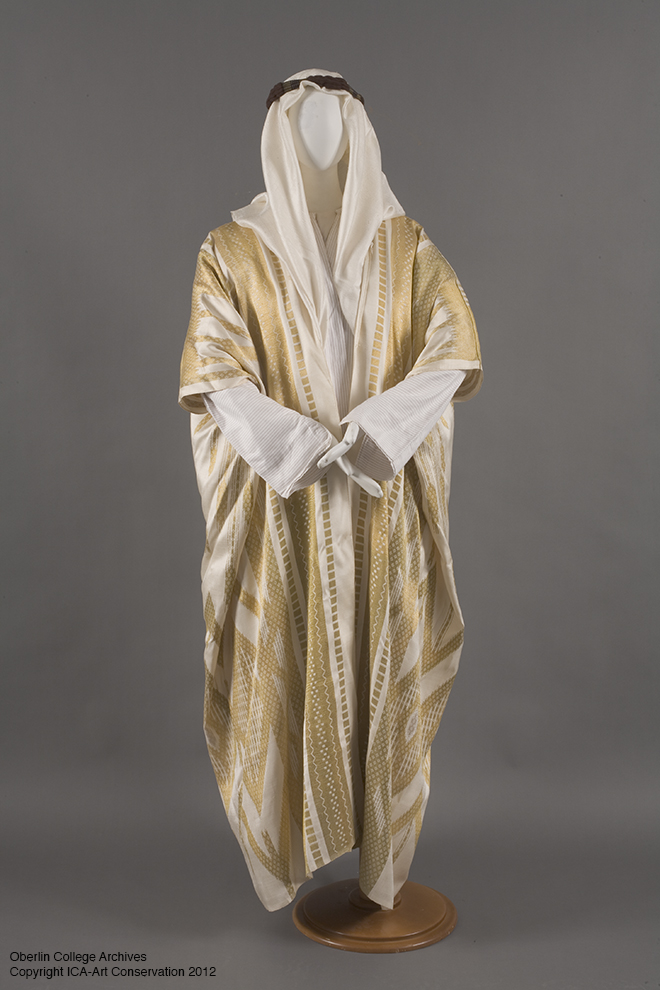
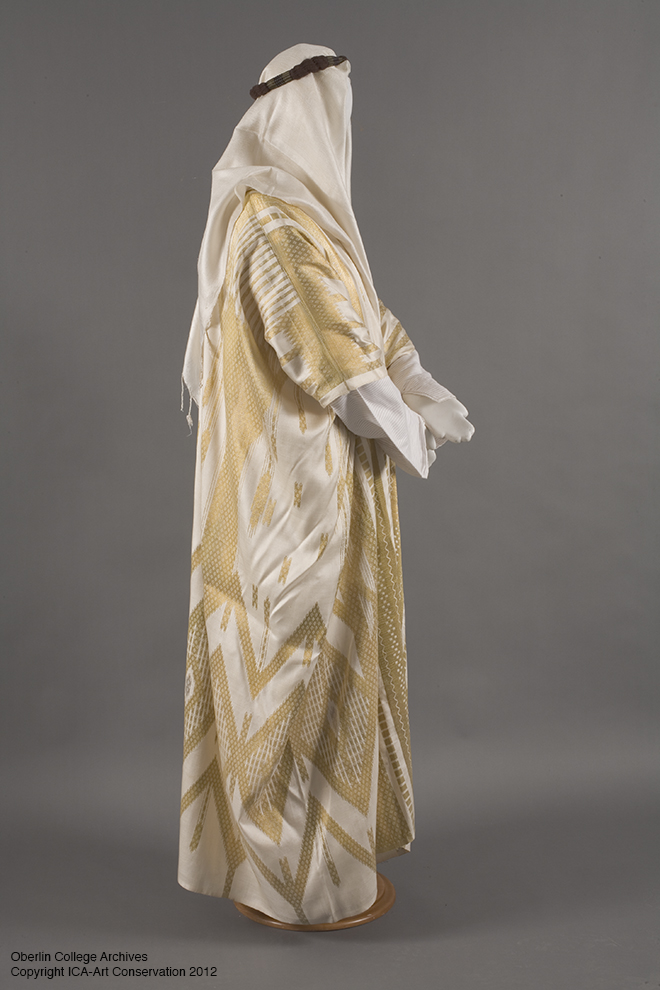
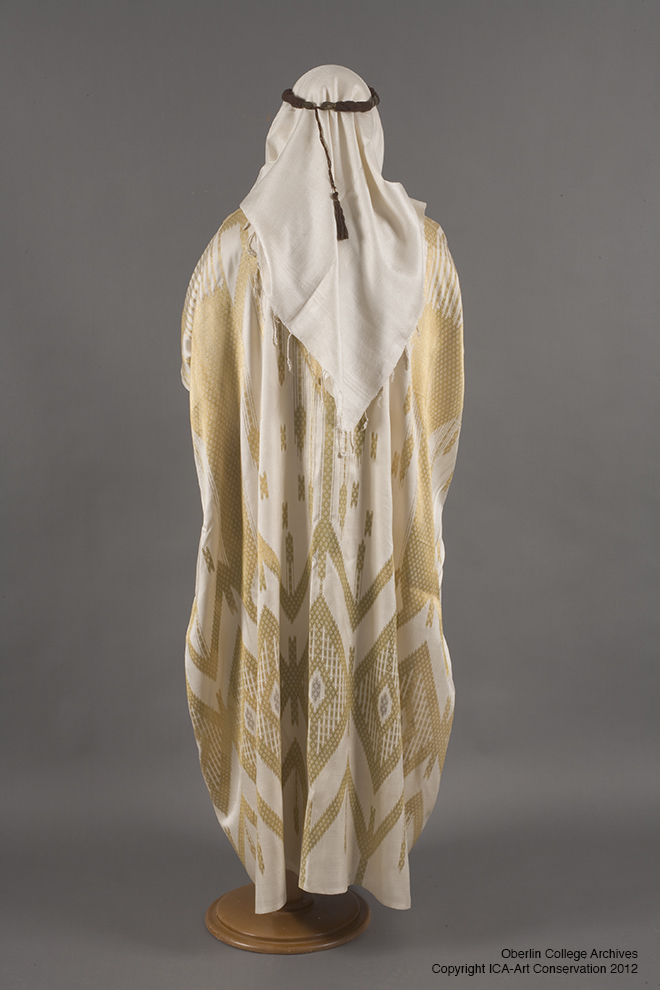
Arab cloth of gold costume, front
1 media/Arab_gold_costume_front_mark_thumb.jpg 2020-10-10T16:47:22+00:00 Anne Cuyler Salsich, Oberlin College Archives 65340b1e79f9df03d291b8de171f6479ab6abb16 30 7 plain 2021-01-25T16:59:48+00:00 ca. 1919 silk, cotton, gold 20120314 144649 Oberlin College Archives John T. Seyfried Copyright ICA-Art Conservation 2012 regional dress Gift of Ernestine Evans King Henry Churchill King Presidential Papers (RG 32/6) The photographs provided here by the Oberlin College Archives for the College Library server may be downloaded for one-time personal or classroom use, if not for financial gain. For all other uses of Archives' photographs--including reproduction in a brochure, scholarly article or book, or other publication (digital or otherwise)--users must seek permission from the Oberlin College Archives (email: archive@oberlin.edu; telephone 440-775-8014). Archives URL: http://www.oberlin.edu/archive/. Images from the Oberlin College Archives are protected by U.S. Copyright law. 1998/146 Anne Cuyler Salsich, Oberlin College Archives 65340b1e79f9df03d291b8de171f6479ab6abb16This page is referenced by:
-
1
2020-10-10T16:53:18+00:00
Robe of Honor from the Emir Faisal
36
plain
2021-02-08T15:45:13+00:00
Title/Subject: Man’s Arab garments
Just after the First World War in 1919, President Woodrow Wilson appointed Oberlin College's President Henry Churchill King (seated left), along with businessman Charles R. Crane (seated right), to lead a delegation (King-Crane Commission) to the former Ottoman territories, to meet with local leaders and receive their petitions for self-determination. The petitions and the Commission’s report were presented at the Paris Peace Conference (1919-20).
Date: ca. 1919
Type: regional dress
Components: kafton, kofia, ekal, giba
Medium: cotton, silk
Collection: Henry Churchill King Presidential Papers (RG 2/6)
At the end of Ramadan on Friday, June 28, 1919, the Emir Faisal (Faisal bin Hussein), son of the Grand Sharif of Mecca, held a formal dinner for Commission members at his home on the lower slope of the mountains northwest of Damascus. Faisal provided his western guests with traditional garments to wear to the feast. To Henry Churchill King he gave a "Robe of Honor," a fine white silk robe (kafton) with an abstract design in gold, commonly referred to as cloth of gold. King wore this with a white silk kofia as head covering, secured with a circlet (ekal) of brown yarn.*
Another set of garments given to King includes a blue silk kafton with gold-threaded embellishment, worn with a tasseled olive-brown kofia and an underdress (giba) of pin-striped cotton. Both sets of garments were given to Oberlin College by Ernestine Evans King, Oberlin College class of 1938 and daughter of H. C. King.
In 2011-12, the College Archives had the garments treated by a textiles specialist of the Intermuseum Conservation Association (ICA). After treatment the garments were mounted on mannequins with reference to a 1919 photograph of the Emir Faisal and photographed by John Seyfried of ICA (shown here).
Henry Churchill King's Presidential Papers in the Archives include extensive documentation of the Commission's work, in documents, maps, petitions and photographs. The King-Crane Commission was the subject of a grant-funded project in which the Oberlin College Archives, a faculty member and two students digitized and contextualized Commission materials from H. C. King's presidential papers and other repositories. Commission members other than College President King had kept materials from their work in the Middle East and gifted them to other archives. The King-Crane Commission digital project brought these materials together for the first time.
In the digital collection one can find the menu for Faisal's feast from the Donald Brodie Collection at the Hoover Institution Archives at Stanford University. The feast is described by at least two Commission members, quoted in Harry N. Howard’s The King-Crane Commission: An American Inquiry in the Middle East.*Terminology used to describe the costume components was provided by Ernestine Evans King, August 5, 1998, as identified by Dr. Omar Z. Ghobashy, information officer with the United Arab Republic Consulate General in New York in November 1960.
Sources
Harry N. Howard, The King-Crane Commission: An American Inquiry in the Middle East (Beirut, 1963).
King-Crane Commission Digital Collection.
Related Collections
Henry Churchill King Presidential Papers (RG 2/6)
Near East Relief Digital Collection