Chinese Robe
1 media/Chinese_robe_front_300_mark_thumb.jpg 2020-10-09T20:29:36+00:00 Anne Cuyler Salsich, Oberlin College Archives 65340b1e79f9df03d291b8de171f6479ab6abb16 30 6 plain 2021-01-25T16:48:42+00:00 ca. 1950s 41 1/2" long silk 20201009 004834 Oberlin College Archives national dress Gift of Carl Jacobson and Deborah Cocco Oberlin Shansi Memorial Association Records (RG 15) The photographs and documents relating to the Oberlin Shansi Memorial Association are provided by the Oberlin College Archives for research and educational use only. For all other uses of photographs and documents--including downloading of images or reproduction in any media--please seek permission from: Oberlin College Archives (http://www.oberlin.edu/archive/contact/form/index.html ). 2020/003 Anne Cuyler Salsich, Oberlin College Archives 65340b1e79f9df03d291b8de171f6479ab6abb16This page is referenced by:
-
1
2020-09-18T19:08:16+00:00
Chinese Robe from H. H. Kung
74
plain
2021-10-01T18:27:25+00:00
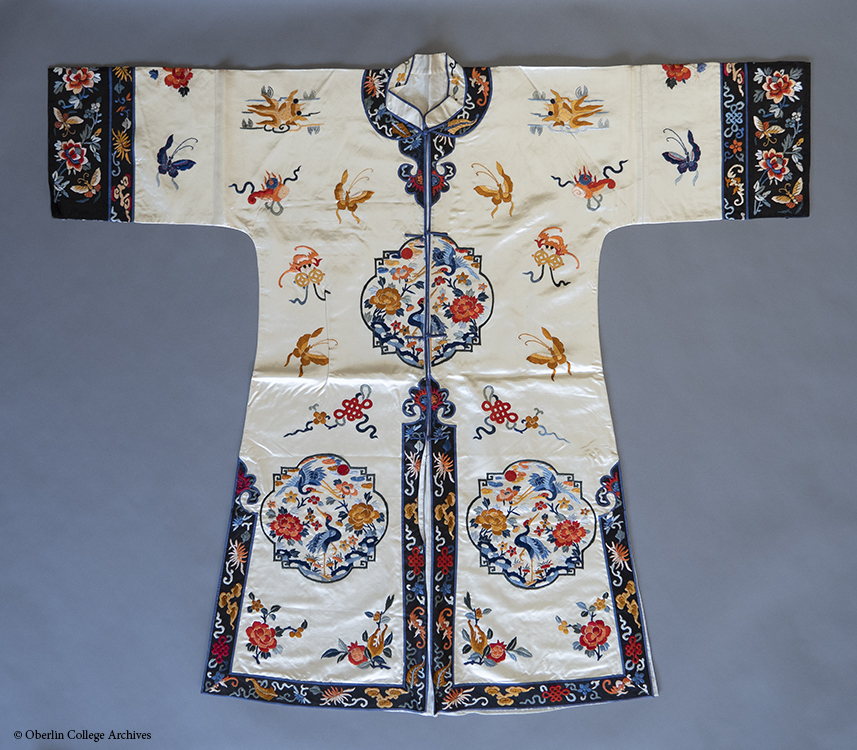
Title/Subject: Woman's Chinese robe
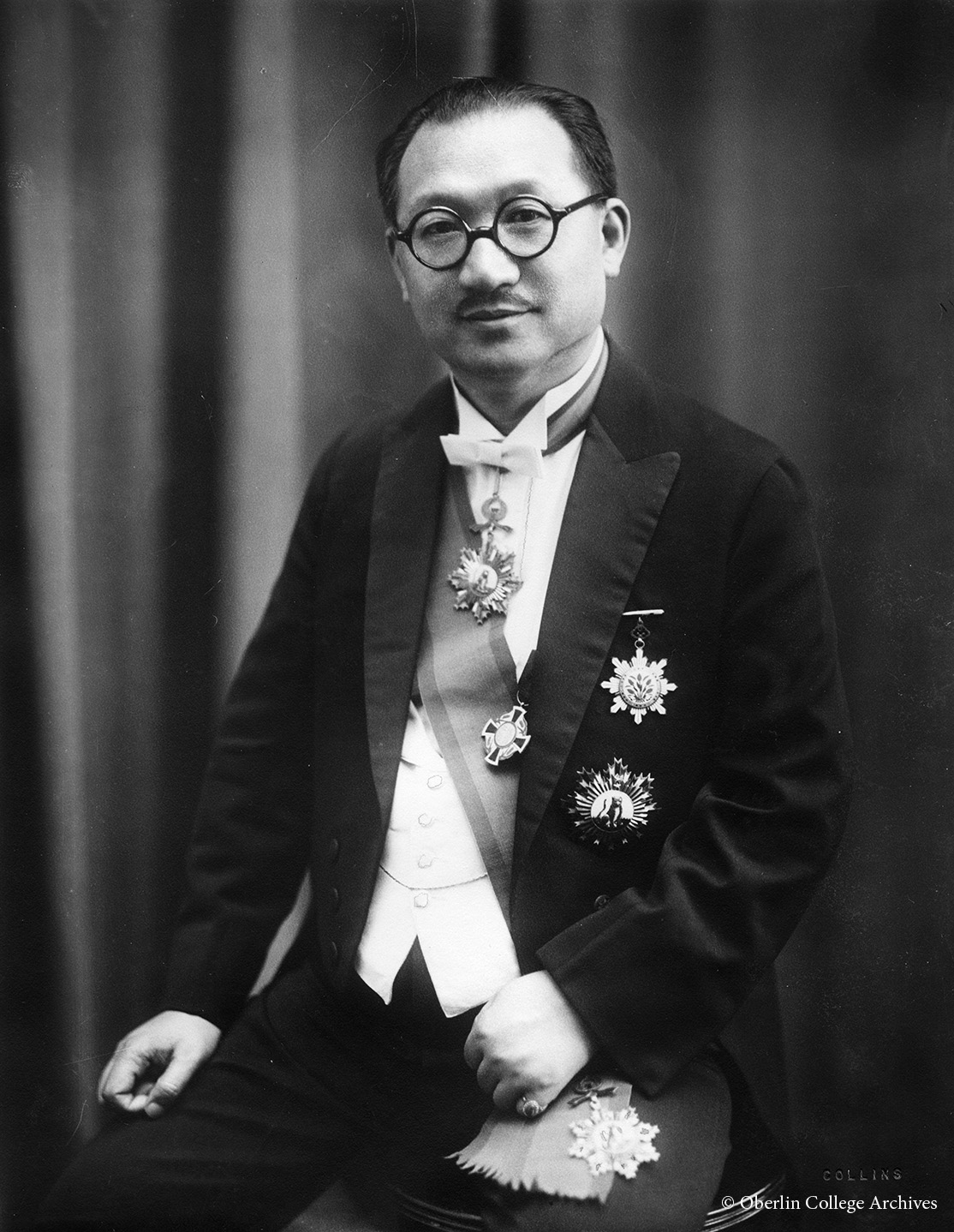
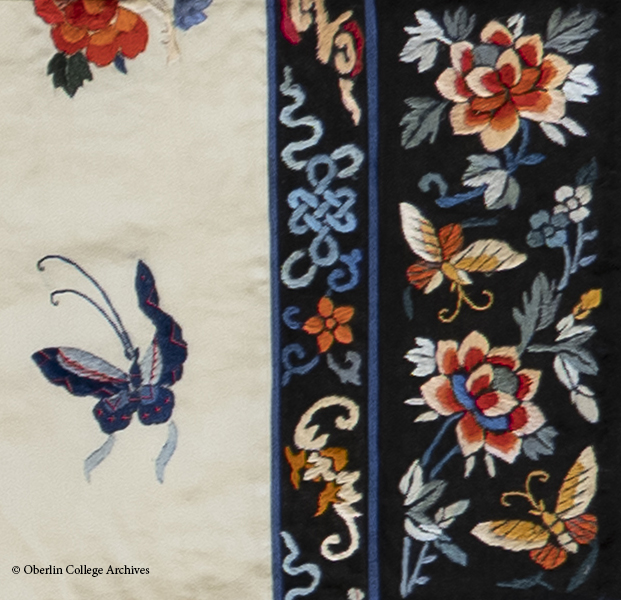
The beautifully embroidered Chinese robe informs the connections between Oberlin College and China. It was given to Margaret Leonard, Executive Secretary of the Oberlin Shansi Memorial Association (OSMA) from 1951 to 1981, by Hsiang-hsi Kung (1881-1967). Oberlin missionaries had worked at Taigu in Shanxi Province to bring education and medical aid in the 1880s-90s; Kung was one of their students. They and other missionaries as well as Chinese Christians were murdered in the Boxer uprising in 1900. Kung was kept at home during the uprising; in 1901 his Oberlin College connections enabled him to enroll at the College, where he graduated in 1906. He then earned an MA in economics at Yale University in 1907.
Date: ca. 1950s
Type: robe
Medium: silk
Dimensions: 41 1/2 in. long
Collection: Oberlin Shansi Memorial Association Records (RG 15)
In 1908, OSMA was established in Oberlin with a board that included widows of slain missionaries to revive and support Oberlin's schools in Taigu. Oberlin College President Henry Churchill King urged Kung to serve as the principal of Oberlin's schools at Taigu, where Kung energetically developed the educational program there for 20 years.
Kung left his position at OSMA's schools for administrative positions in the Government of the Republic of China. He was Minister of Industry and Commerce (1928–31), joined the Central Executive Committee of the Kuomintang in 1931, Minister of Finance from 1933–44, and also Governor of the Bank of China from 1933–45. He was concurrently the Vice President of the Executive Yuan. He served as Premier of the Republic of China from January 1938 to November 1939. In these highest positions of government and finance he made a very strong and mixed impression on the development of China during the extremely trying times of the Japanese Invasion, World War II and the Civil War between the Nationalists and the Communists.
In addition to the schools, OSMA developed an agricultural research and educational center in Shanxi until the Chinese Communist government expelled the program's representatives by 1951. Margaret Leonard worked in Oberlin, supporting the China program's representatives as they transitioned out of China, and the establishment of programs in India, Taiwan, Japan and Thailand. Kung's gift to Leonard would have been made sometime between Leonard's appointment in 1951 and Kung's death in 1967.
H. H. Kung remained deeply committed to Oberlin College and OSMA throughout his life and career. An anonymous gift made to the College in his honor funded the construction of a new Science Center complex on campus in 2002. Oberlin Shansi continues to support its educational programs in Asia, with representatives drawn from Oberlin graduates.
Sources
Margaret H. Leonard oral history transcript, Oberlin Shansi Memorial Association Records (RG 15)
Shansi: Oberlin and Asia Digital Collection
Related Collections
Oberlin Shansi Memorial Association Records (RG 15)
Francis W. and Lydia Lord Davis Papers (RG 30/80)
Ellsworth C. Carlson Papers (RG 30/176)
Chinese Women's Robe, Archives Museum Collection